Multiple Authors
The True Cost of Poisoned Water
Heer Bhathawala, Eve Nevelos, Yash Maheshwari , James Oehmke
The True Cost of Poisoned Water
Concerns about drinking water contamination have increased in recent years, especially as greater emphasis is being placed on the presence of per- and polyfluoroalkyl substances (PFAS) in water, soil, and even human blood. Studies on the relationship between PFAS consumption and health conditions have found a noncausal link (at this time) between PFAS and immune, reproductive, and liver health, as well as cancer (3).
PFAS are a diverse group of synthetic chemicals resistant to water, oil, and heat due to strong, stable organofluorine chemical compounds with a central alkyl chain (6). PFAS were used, and in some cases are used, in cleaning products, cookware, firefighting foams, paints, and a variety of industrial products (6). Many of these chemicals have leached into the environment, contaminating waterways, soil, and the air (1).
PFAS remediation is a multi-step process, with water filtration and waste treatment being critical to sustainable success (2). Anion Exchange Resin (IEX), Granular Activated Carbon (GAC), and High-Pressure Membranes are the primary filtration methods (5). After filtration, the waste accumulated in the filters must be properly disposed of or destroyed, with incineration being the most widely practiced method.
This essay briefly describes and economically evaluates the PFAS remediation technology used at Lake Stockholm Systems, Inc. in Stockholm, New Jersey. Specifically, it conducts a benefit-cost analysis (BCA) of a common PFAS remediation technology most similar to that currently used at the Lake Stockholm facility. This BCA provides useful information for small municipalities concerned with PFAS in their water systems as they determine the best way to remediate the problem.
Lake Stockholm Water System PFAS Remediation
Lake Stockholm Systems, Inc. (Stockholm, NJ) secured a $1.7M New Jersey (NJ) Water Bank loan in 2024 to address PFAS exceedances, implementing a nanofiltration (NF) primary barrier paired with an Aqueous Electrostatic Concentrator (AEC) for concentrate management. The system is flow-through and has 3 chambers, with 2 membranes between them. All waste is collected on-site in an evaporative drum and later destroyed by Biolargo (parent company).
Lake Stockholm is a small, predominantly residential municipal water system producing ~0.2-0.25 million gallons per day (MGD), where treatment costs and operational complexity directly affect water rates and staffing requirements.
To evaluate the economic viability of this implementation, a 30-year benefit-cost analysis of the Reverse Osmosis/Nano-Filtration (RO/NF) + AEC configuration was conducted across two discount rates (2% and 8%) using deterministic calculation. Sensitivity analysis was conducted using Monte Carlo simulation methods. The economic evaluation of the system involves calculating the benefit-cost ratio and the net present value of each investment at each discount rate for each practical methodology.
Under deterministic assumptions, the system yielded an NPV of $13.17M and a BCR of 6.26 at 2%, and an NPV of $5.78M and a BCR of 3.75 at 8%. Monte Carlo simulation produced mean NPV estimates of $13.04M (P5–P95: $6.51M–$19.42M) and $5.63M ($2.36M–$8.93M) at 2% and 8%, respectively, with corresponding mean BCRs of 6.07 and 3.60.
Although RO/NF + AEC carries the highest capital and operations costs among methodologies explored, lower-bound P5 NPVs remain consistently positive across both rates.
The cost premium reflects membrane replacement, energy demand, and AEC consumables, offset by broad-spectrum removal across all PFAS chain lengths, on-site destruction reducing disposal liability, and resilience to future regulations. Taking an unsubsidized rate (8%) compresses NPV by roughly 55–60% and BCR by 35–45%, though the system remains robustly net-beneficial under both scenarios. The wide 90% confidence intervals underscore the importance of site-specific validation, with key uncertainty drivers including PFAS speciation, local energy and chemical costs, and the trajectory of monetized health benefits as more information is gathered.
New generation models use 80-90% less energy than the system currently used at the Lake Stockholm facility, despite less than two years since installation. This economic evaluation reflects the costs of a smaller case study with limited parameters and practicalities. However, these decisions become significantly more complicated at larger scales. Even for the Middlesex Water Company (serving New Brunswick), shifts in decision-making and actual remediation value can swing the NPV of these investments over $100 million at lower discount rates. The mean deterministic NPV for providing PFAS remediation in Middlesex County is negative.
Ultimately, the decision surrounding PFAS treatment cannot be reduced to economics alone. While financial metrics such as NPV and BCR provide municipalities with essential guidance, the broader implications for public health, community trust, and long-term environmental resilience must also be considered. As PFAS research continues to evolve, municipalities have an opportunity, and a responsibility, to act proactively rather than reactively.
For a deeper analysis, see our full paper.
References:
- ATSDR perfluoroalkyls (PFAS) ToxGuide. U.S. Department of Health and Human Services Public Health Service Agency for Toxic Substances and Disease Registry. (n.d.). https://www.atsdr.cdc.gov/toxguides/toxguide-200.pdf
- BeyondPFAS. Veolia North America. (n.d.). https://www.veolianorthamerica.com/pfas-treatment
- BioLargo, Inc. (2025, November 3). BioLargo cuts AEC PFAS treatment energy use by >90%, unlocking commercial-scale water solutions with unmatched total life cycle cost savings. Water Online. https://www.wateronline.com/doc/biolargo-cuts-aec-pfas-treatment-energy-use-by-unlock ing-commercial-scale-water-solutions-with-unmatched-total-life-cycle-cost-savings-00014
- Daily exposure to “forever chemicals” costs United States billions in health costs. NYU Langone News. (2022, July 26). https://nyulangone.org/news/daily-exposure-forever-chemicals-costs-united-states-billions-health-costs
- Environmental Protection Agency. (2024, November 26). Our Current Understanding of the Human Health and Environmental Risks of PFAS. EPA. https://www.epa.gov/pfas/our-current-understanding-human-health-and-environmental-risks-pfas
- Per- and Polyfluoroalkyl Substances (PFAS). Dep.nj.gov. (n.d.-a). https://dep.nj.gov/pfas/standards/
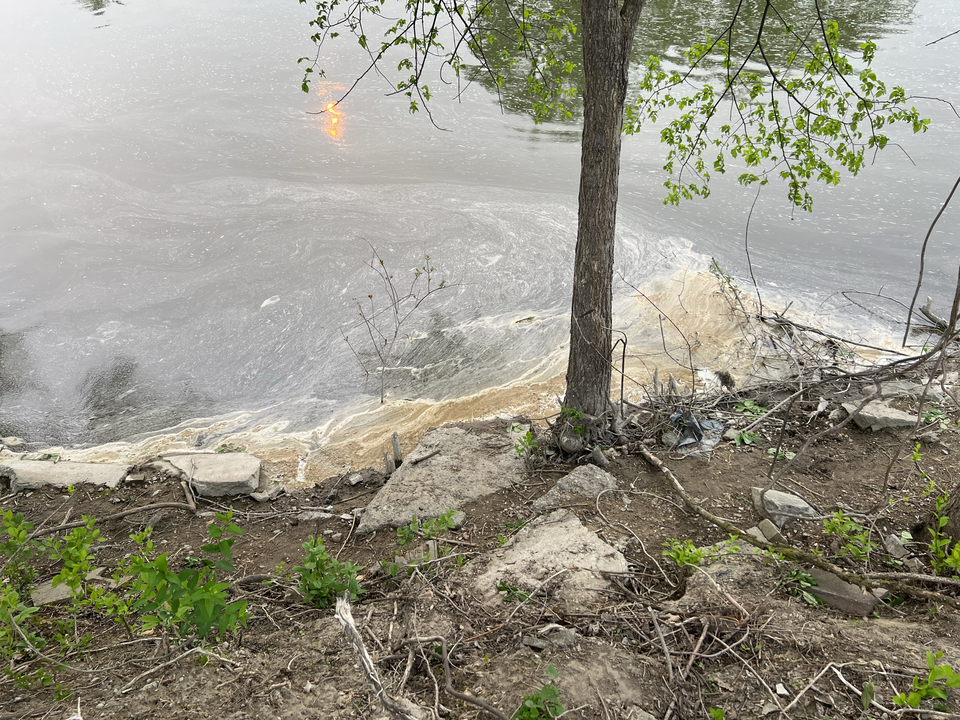
Photo Credit: Mountainfae May 19, 2023 Wikimedia Commons
Foam containing PFAS on the shore of a river…

Heer Bhathawala
Contributor
Heer Bhathawala is a recent graduate from Rutgers Business School and is passionate about harnessing the power of data to address real-world challenges that create meaningful impact in communities. Through the MBS externship program, she gained hands-on experience with the Rutgers Department of Agriculture, Food, and Resource Economics (DAFRE), applying data-driven approaches to issues at the intersection of business and society. She will be joining the Rutgers Master of Business and Science program, where she plans to specialize in Data Analytics and Artificial Intelligence.

Eve Nevelos
Contributor
Eve Nevelos is a second-year student at the School of Environmental and Biological Sciences (SEBS) at Rutgers University. She is pursuing a Bachelor of Science in biotechnology with minors in microbiology and plant science. She works as a research intern at DAFRE and as a research lab assistant in the Zhang Fungi Lab. Research interests include environmental microbiology, bioremediation, bioinformatics, and microbial metabolism.

Yash Maheshwari Contributor
Yash Maheshwari is a recent Data Science graduate from Rutgers University–New Brunswick with a deep interest in the intersection of law and technology. Having secured his place at Rutgers Law School beginning in the Fall of 2027, he is spending his gap year traveling, pursuing self-directed study, and gaining as much legal experience as possible before beginning his legal education.
Yash brings hands-on analytical experience from his work with Colgate-Palmolive and the Rutgers Division of Agriculture and Natural Resources (DAFRE), where he contributed to data-driven projects that sharpened his research and problem-solving skills. He now seeks to apply that foundation in legal settings as he prepares for the next chapter of his career.

Ashika Nadella Contributor
Ashika Nadella is an aspiring UI/UX designer and a Computer Science graduate from Rutgers University. She previously served as a PMO Analyst Co-op at Ahold Delhaize USA and worked as a Data Visualization Analyst extern at Griffiss Institute through the Rutgers MBS Externship Program. She is passionate about designing end-to-end user experiences and hopes to get involved in meaningful projects that solve real-world user problems in the digital space.

Vamsi Krishna Murali
Contributor
Vamsi Murali is a Finance and Data Science student at Rutgers University.
Our Future?
Aryel Zhang
The true cost of poisoned water
Heer Bhathawala, Eve Nevelos, Yash Maheshwari, James Oehmke
Isla Vista Gallery Night
Leah Jensen