Stacy Morgan
Science and Spirit: reading the water at Buttonhook Forest
Stacy Morgan
Science and Spirit: Reading the Water at Buttonhook Forest
Western science and Indigenous knowledge tell the same story at Buttonhook Forest’s headwaters. Buttonhook Forest sits within New York City’s watershed and contains headwaters that feed streams flowing into the New Croton Reservoir, supplying drinking water to millions. What happens in small, forested headwaters like these can have ripple effects far downstream.
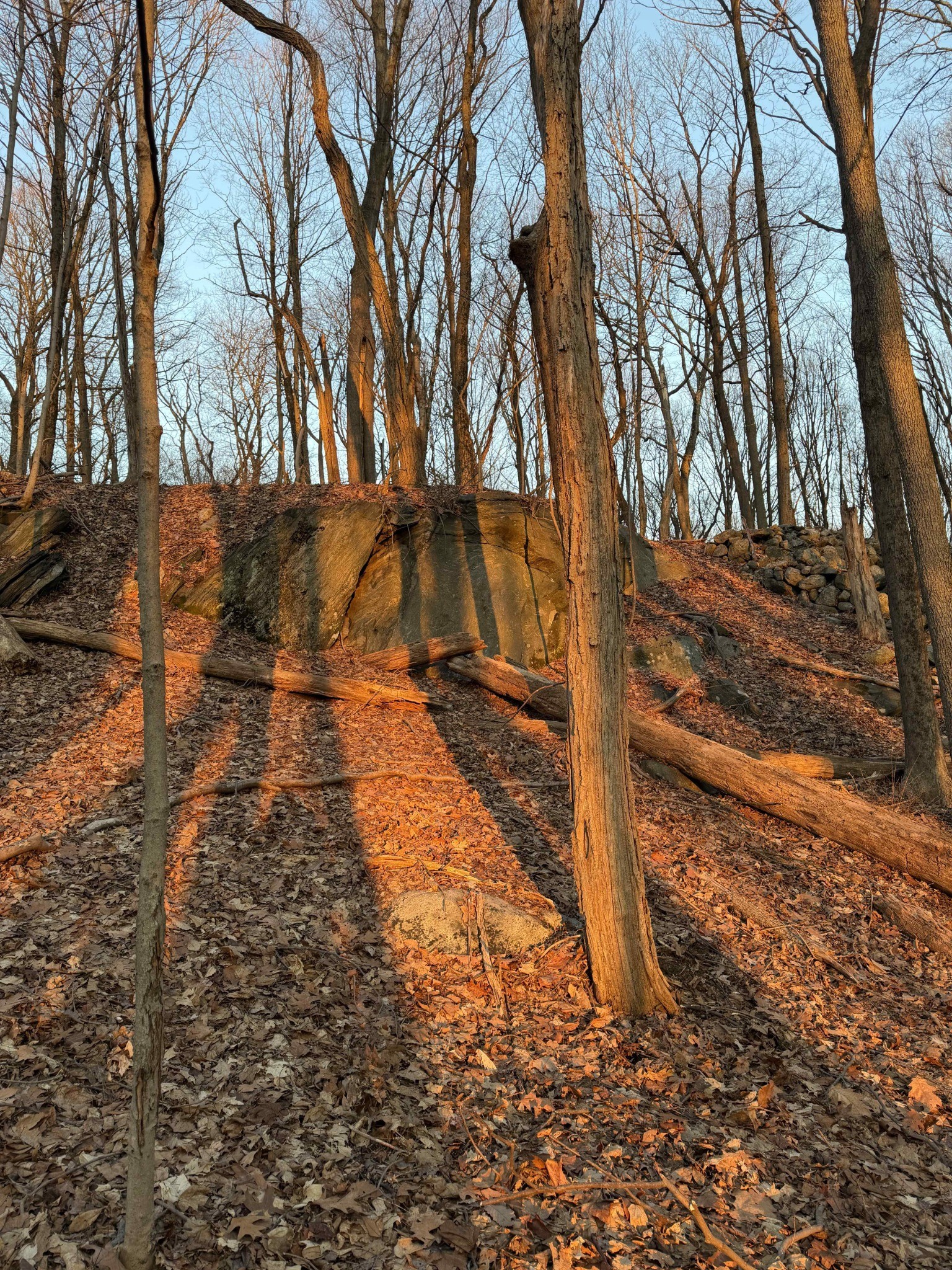
In early Spring, when walking through Buttonhook Forest in Chappaqua, New York, you may notice an unusual sight high up on the rocky outcrops. Skunk cabbage, Symplocarpus foetidus (Latin) or Tsorà:kare (Mohawk), blooming up on the hilltop. These water-loving tropical-looking plants are usually found in streambed and low-lying ditches. Looking closely at the rock base where the skunk cabbage is flourishing, you will observe a spring babbling out from the ground. For those who know how to read the land, this forest reveals a deeper story — one written in water.
For Indigenous peoples, water is never simply a resource. In many Indigenous languages living things are not referred to as ‘it’. The living world is addressed as kin, relatives. Relations also include entities that encompass ‘life energy’ such as fire, rocks, mountains, rivers and water. All relations are shown respect. Water is understood as a living presence — something sacred that connects land, people, and life itself. Knowledge of water — where it flows, where it gathers, and where it rises from the earth — is essential to survival and part of a spiritual relationship with the natural world.
Water is understood as a bridge between worlds. The Algonquian-speaking peoples of the Northeast, including the Lenape and Wappinger, believe the earth exists between layers of creation: the sky world above and the underworld below. Water — particularly springs, flowing streams, and underground currents — is often seen as a place where these realms meet.
For Indigenous communities, the land is the initial instructor, revealing life lessons to those who pay attention. Over generations they observed and learned to recognize the subtle signs of underground flows — shifts in soil moisture, certain plant communities, cold-air pockets, and places where water returned to the surface after traveling unseen through rock and soil.
Indigenous science integrates traditional knowledge with scientific methods, emphasizing careful observation, experimentation, and interpretation within a cultural and environmental context. Unlike Western science, which often seeks universal laws, Indigenous Science is place-specific and case-based, reflecting the unique relationships between communities and their environments. It is holistic, encompassing physical, social, mental, and spiritual dimensions, and prioritizes balance with nature.
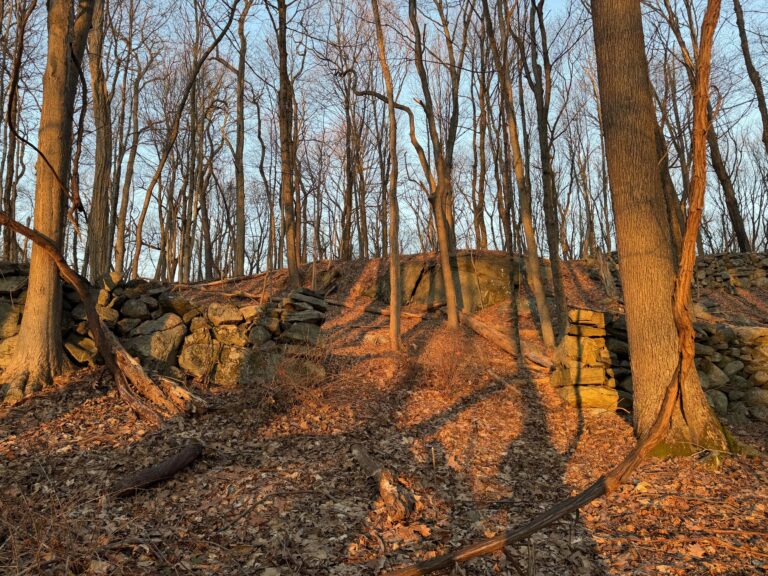
Indigenous science is a key factor in the study of Buttonhook Forest. Indigenous mentors describe a ceremonial landscape that includes intentionally placed stone features. Some of these features are understood to mark underground water flows and springs. Long stone walls, called snake walls, undulate in the direction of the aquifers. Long before maps, surveying equipment, or hydrological models, people read the landscape and recorded that knowledge in ways that could endure across generations.
Today, western science offers another lens for understanding the same landscape. Hydrology — the study of how water moves through soils, rock, and waterways — confirms that forested hilltops like Buttonhook Forest often serve as the birthplace of local streams.
Rainwater and snowmelt filter slowly through layers of soil and fractured bedrock, feeding aquifers that eventually emerge as springs and small channels of water known as headwaters. Though they may appear small or seasonal, headwaters play a crucial role in shaping entire watershed systems. They influence water quality, regulate stream flow after storms, and provide habitat for local biodiversity.
This is why protecting forests in watershed areas is imperative. Trees and deep forest soils act as natural water filters. When rain falls on an intact forest, the canopy slows the rainfall, allowing it to soak into the ground gradually. When forests are replaced by roads, rooftops, and driveways, that natural filtration system is destroyed. Rainwater runs quickly across hard surfaces, carrying sediment, nutrients, and pollutants directly into nearby waterways. Increased runoff can also intensify flooding and erode stream banks, damaging the health of aquatic ecosystems and threatening downstream water supplies. In reservoir watersheds like the Croton system, protecting intact forests is one of the most effective ways to safeguard clean drinking water.
What makes Buttonhook Forest especially meaningful is how two very different ways of understanding land arrive at the same conclusion. Indigenous knowledge recognizes the sacred nature of water and teaches that people have a responsibility to protect aquifers. Modern watershed science, working through measurement and environmental regulation, demonstrates that protecting forested headwaters are essential for maintaining healthy water systems. One speaks through ceremony, story, and relationship with the land. The other speaks through hydrology, ecology, and environmental policy. Yet both perspectives point to the same truth: protecting undeveloped land is protecting water.
There is a striking confluence of western science and Indigenous knowledge in the story of Buttonhook Forest. Long before hydrological studies or environmental regulations existed, Indigenous peoples recognized the significance of water moving through this ridge. Today, modern watershed science identifies the same landscape as sensitive headwaters connected to the New Croton Reservoir system.
Concerns about stormwater management, groundwater flows, and protection of the New York City watershed ultimately became part of the regulatory review process that questioned the destruction of Buttonhook Forest. Indigenous knowledge passed down through generations — that protection of headwaters is essential — became one of the very reasons why planned development could not be authorized.
As conversations continue about the long-term protection and Indigenous stewardship of Buttonhook Forest, this place offers important lessons for our time.
In an era of a warming planet and water insecurity, Indigenous science must be acknowledged and implemented. While working to save Buttonhook Forest, as a scientist trained in western methodology, I have learned that to solve the greatest environmental issues of our lifetime, we must work with Indigenous scientists and mentors. We must pay attention – to extend reciprocity – to the relations that share this planet. Water, like land and forests, must be shared rather than commercialized. When communities choose to protect these headwaters, they are safeguarding more than a piece of land. They are protecting culture, history, biodiversity, and clean water that sustains life for generations to come.
Stacy Morgan
Author
Stacy Morgan is a scientist and environmental activist. She is a founding board member of Friends of Buttonhook Forest Inc., a 501(c)(3) nonprofit working to save and preserve a 20-acre forest watershed and its recently discovered Native American ceremonial stone complex in Chappaqua, New York.
Stacy runs the organization’s outreach events, communications, and social media. She is passionate about protecting local biodiversity, recognizing Indigenous knowledge and supporting the rematriation of land.
Stacy is also a member of Mothers Out Front, a group that lobbies local and state representatives on climate legislation to make New York State more climate progressive. She has successfully lobbied with the Climate and Resilience Education (CRE) Taskforce to introduce an amendment requiring New York statewide K-12 interdisciplinary climate education.
Foreword: A Long Time Ago
John L. Parker, Esq.