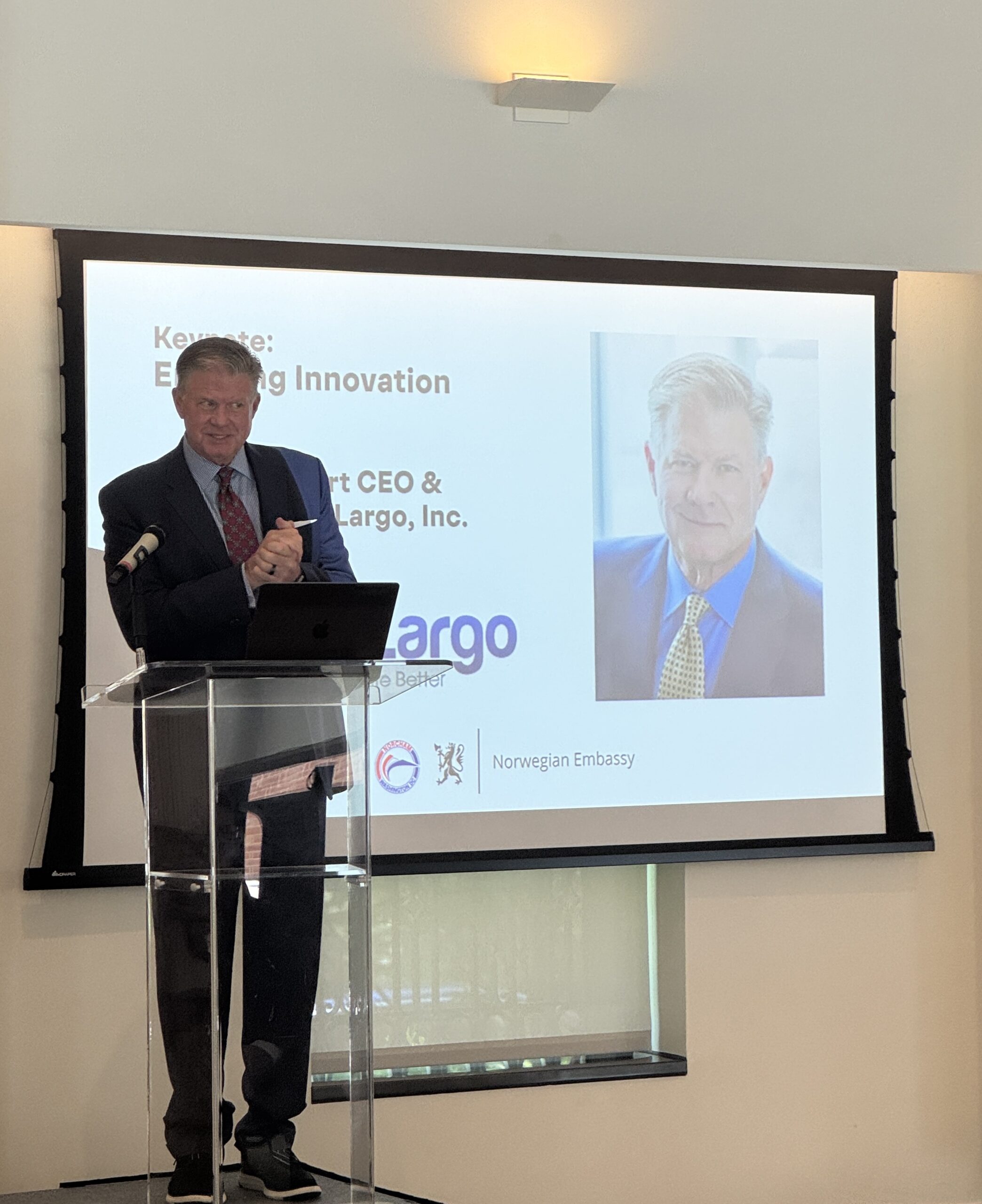
Dennis Calvert
Norway means Business: Keynote Address
Dennis Calvert, CEO & Chairman, Biolargo, inc.
Norway Means Business -
Keynote address
June 11, 2026
Ambassador Huitfeldt, distinguished guests, friends — thank you.
And thank you, Norcham and Idar Voldnes and, of course, thank you Norway, for opening this house to look into a problem that doesn’t carry a passport and doesn’t respect a border.
I want to begin with a small confession. I’ve spent a little over twenty years of my life in the innovation business. Which means …I’ve spent a little over twenty years asking a two-word question that has cost me ….and a number of very patient shareholders — a considerable amount of money. The question is: “What.. if?”
My accountant has a different favorite question….. “Why?” even better, ….What were you thinking?
The two of us have had a long and productive marriage.
But here is what twenty years has taught me. Every meaningful thing on the agenda today — every technology, every company, every solution — began as somebody’s slightly inconvenient question, “what if.”
What if we could clean water where the old chemistry said we couldn’t?
What if “forever” wasn’t actually forever?
Curiosity is the cheapest ingredient in innovation. It’s also the one we quietly skip. We’re trained to admire the answer and ignore the question. But the question is the asset. The “what if” is the seed of everything that comes after it — and most of the time, it shows up disguised as a nuisance. The best ideas almost always sound, at first, a little unreasonable.
Curiosity points you at a problem. Then the unglamorous part begins: the deep dive. You go and study the gap.
Not the crowded market everyone is already fighting over — the gap.
The place where the need is enormous and the solutions are thin. As an innovator, you learn to fall in love with gaps, because a gap is just opportunity that nobody has claimed yet.
For me, the PFAS gap didn’t begin with a spreadsheet or a lab report. It began, of all places, with a movie. Some of you have seen Dark Waters — the story of how a class of “forever chemicals” quietly made its way into the blood of, …essentially, …all of us.
What that film captured — more vividly than any data set I’d ever seen — was the visceral reaction: that moment you realize a contaminant has become this widespread, this permanent, and that someone, somewhere, has to decide to fix it.
These are molecules we engineered to be nearly indestructible — and they did their job a little too well.
They’re in our water, our soil, and …in us.
We’re the first generation able to measure them down to parts per trillion, which makes us the first generation that has to decide what to do about them.
My company decided to be one of those “someones.” That is a gap worth a career.
And that brings me to the third word.
Courage.
Because studying a gap is interesting.
But committing your life, your reputation, and other people’s capital to closing one — that is something else entirely.
Every founder in this room knows a particular piece of geography. We call it the valley of death. It’s the distance between “the technology works in the laboratory” and “the world will actually pay for it.” It is where good ideas go to quietly… not make it.
It’s a crowded valley — full of brilliant technologies that were absolutely right, and absolutely alone. Because a breakthrough with no bridge is just an expensive opinion. Courage gets you to the edge of that valley. It does not, by itself, get you across.
Let me make that personal, because I have lived in that valley.
One of our companies, Clyra Medical, has spent nearly twelve years — and a great deal of precious capital — carrying a breakthrough in infection control and wound healing toward the market. The technology worked… really well. And that, it turned out, was the problem.
Because the objection we heard most often wasn’t “it doesn’t work.” It was:
“This is too good to be true.” We were effective enough that being effective became suspicious. And clearing that one objection — satisfying even the regulators — cost us an additional three and a half years of work and investment. Three and a half years to overcome the crime of working too well.
But we went the distance and came out stronger and more determined to make change for a greater good. And today Clyra is in early market adoption, launching with global partners and industry leaders finally taking up the cause.
Which brings me to the two questions every innovator in this room will recognize. The first you’ve just heard: “Isn’t this too good to be true?” The second is even better: “And who the heck are you?”
As if real innovation were reserved for the upper echelons of academia, or a handful of super-scientists in lab coats. That’s the myth I most want to retire today.
Innovation isn’t a credential — it’s a commitment.
It’s the discipline to ask the “what if,” the patience to do the deep dive into the gap, and the courage to go the distance when everyone — including the regulator — is telling you to stop. That’s the whole secret. There isn’t a second one.
But here’s the lesson that took me twenty years to learn: courage gets you across the valley — partnership is what lets you scale on the other side.
With PFAS, we made a deliberate choice early on.
Not just to build a technology that works — but to build a strategy around it: strategic partnerships that let a proven solution scale at a global pace. Because political winds ebb and flow, budgets tighten, administrations change — but the need for a better solution only gets clearer.
And that strategy is why we now get to watch a technology once waved off as “too good to be true” being adopted around the world and scaling at the highest level — with partners standing alongside us.
Just recently we formed a strategic alliance with Aquatech — and it’s a textbook case of what I mean. Two organizations, different strengths, but mutual incentives that line up perfectly to go after the same gap. Because a problem of this scale isn’t solved by a lone hero in a garage. It takes an army of committed innovators and scaled partners to do it right. And happily — you’ll hear from one of those partners in just a moment: Aquatech’s CEO, Devesh Mittal, is right here on this panel.
So partnership at that scale isn’t just a company strategy. It’s a national one. Which is the reason we’re standing in this particular building today.
I have the privilege of serving on a U.S. federal environmental technology trade advisory committee, where we argue — politely… mostly — that the job of good policy is to shift from punishing what’s dirty to enabling what’s better.
From compliance to enablement.
Easy to write in a memo. Very hard to do. (I should mention at this moment that all my comments are my own and I am not authorized to speak on behalf of the Secretary of Commerce or the US Government.)
And then I look at Norway, and I realize they’ve quietly been doing the very thing the rest of us keep writing memos about. Norwegians are far too modest to brag about it — so allow an American to do it for them.
Norway didn’t subsidize the world’s largest fleet of electric ferries into existence. It bought them into existence — it used its own purchasing power as an innovation engine. When the government agreed to be the first customer, the valley of death suddenly had a bridge. And its agencies don’t just fund the science; they help underwrite the terrifying middle — the first full-scale deployment private capital is too sensible to finance alone — and, unlike most of us, they actually coordinate with one another.
And then there’s the remarkable project. Norway built the world’s first full-scale system to capture carbon dioxide and lock it permanently beneath the seabed. The government covered roughly two–thirds of the cost, and it began storing carbon just last year. Do you know what they named it?…
Longship. … Of course they did. Because a thousand years ago, Norwegians climbed into open wooden boats and rowed toward a horizon they had no way of seeing. The boat, I’ll grant you,…. has gotten considerably more expensive. But the instinct is exactly the same: point yourself at the unknown — and commit.
So here is the whole arc, in four words.
Curiosity, to ask the question.
Rigor, to study the gap.
Courage, to commit when no one can promise you it will work.
And partnership — the infrastructure, the policy, the patient public WILL — to build a bridge across the valley so the courageous don’t have to cross it alone.
Which is exactly why we’re here this afternoon. The technologies you’re about to hear about on this next panel are not science projects. They’re real, working solutions to PFAS — built by people who asked “what if,” studied the gap, and found the courage to commit. What they need from the rest of us — policymakers, partners, capital — is the bridge.
So here’s the one thing I’d ask you to carry out of this beautiful room. Innovation doesn’t fail in the laboratory. It fails in the gap — between a technology that works and a market that’s ready.
Closing that gap is not an accident. It’s a choice. And it’s a choice every single person in this room has some power to make.
It’s my honor to introduce a group of people who have made that choice — and the solutions they’ve built.
And, a very special thank you to Dr. Cynthia Phillips of 22nd Century by Design for creating this awesome event and making this day a reality!
“If there’s one lesson I carry, it’s this: keep returning to the question, then commit to the bridge. Curiosity, rigor, courage—and partnership. Thank you—over to the panel.
Dennis P. Calvert
CEO & Chairman, BIOLARGO
Dennis P. Calvert is BioLargo’s President, Chief Executive Officer and Chairman of the Board, and is chairman of the board of directors of each of ONM Environmental and Clyra Medical Technologies, both BioLargo subsidiaries. Mr. Calvert holds a B.A. degree in Economics from Wake Forest University where he was a varsity basketball player, and he also studied at Columbia University and Harding University. He serves on the Board of Sustain SoCal, a trade association that seeks to promote economic growth and stimulate innovation in the Southern California clean technology industry. He also serves on the Board of Directors at TMA BlueTech, the leading regional water cluster promoting science-based ocean and water industries and also serves on the Board of Directors of the Maximum Impact Foundation, a non-profit organization committed to bridging the gap for lifesaving work around the globe for the good of man and in the name of Christ.
Norway Means Business: PFAS Challenges Facing Communities Across the Globe
Master of Ceremonies: Idar Voldnes
Norway Means Business: Keynote Address
Dennis Calvert
CEO & Chairman, Biolargo, Inc.
Norway Means Business: Opening Remarks
Moderator: John L. Parker, Esq.