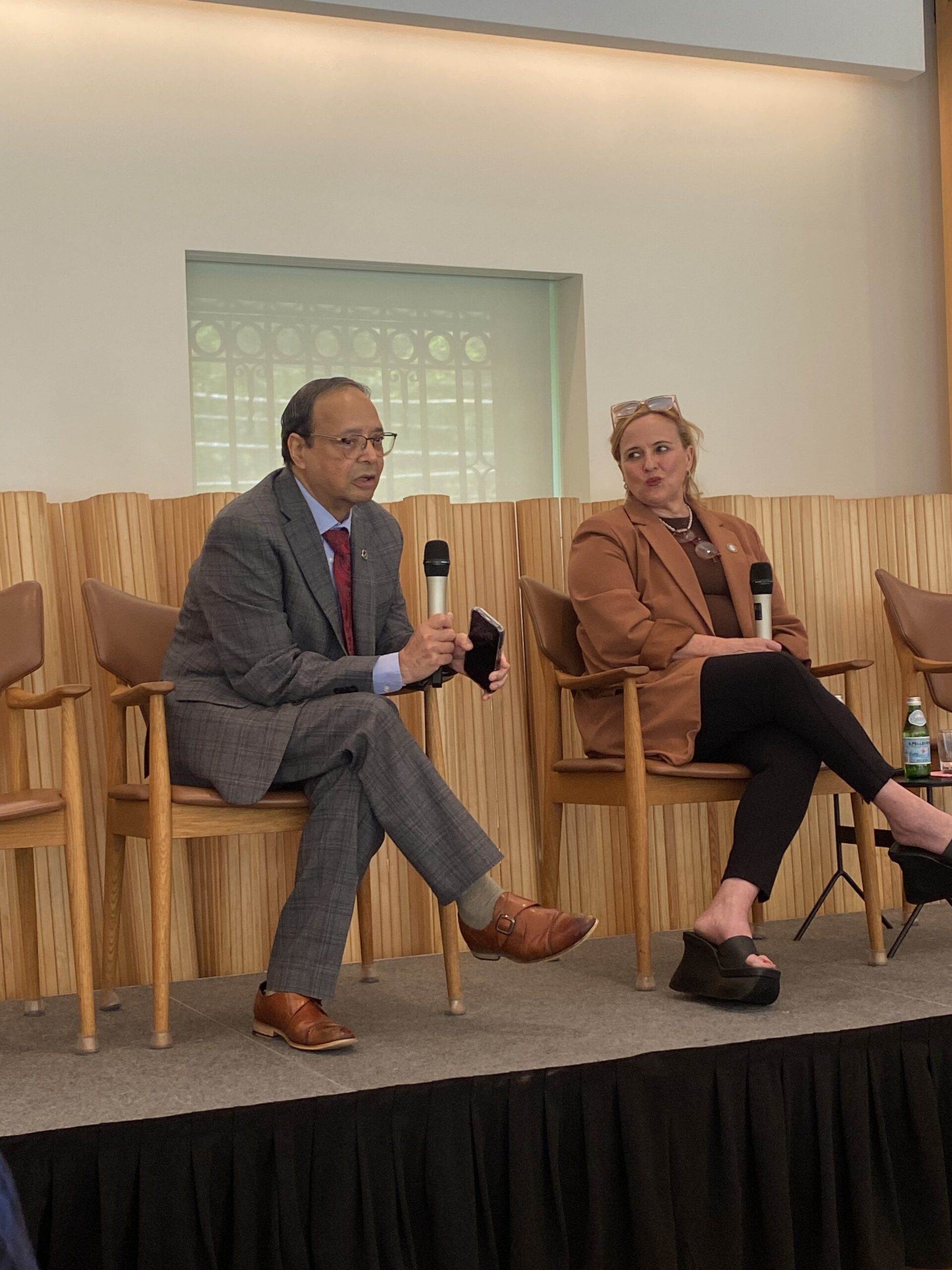
Atam Dhawan, Phd
Addressing Global PFAS Challenges Needs Partnership Innovation
Atam P. Dhawan, Ph.D.
Addressing Global PFAS Challenges Needs Partnerships Innovation Ecosystem
PFAS (per- and polyfluoroalkyl substances), often called “forever chemicals,” are found in everyday products and persist in groundwater, drinking water, wastewater, soil, consumable products and waste, food, and the environment. This family of chemicals poses serious public health risks including increased cholesterol, liver damage, thyroid disease, and can result in changes in the immune system. There’s also evidence suggesting a link between PFAS and decreased fertility, high blood pressure in pregnancy, lower birth weight, and increased risk of certain cancers.
The gravity of PFAS contamination has evolved to a critical global systemic challenge. It arises from the cyclic process of use of these chemicals, ranging from industrial manufacturing to consumable products and materials such as paint, wax, packing and construction materials to waste and groundwater to food, drinking water and environment. There are already more than estimated 15,000 PFAS chemicals and their bi-products that are being used in our society in different ways and systems around us. Their long-term health impacts and resistance to breakdown have made remediation especially complex. The PFAS crises is escalated at the national and global levels that can only be tackled through collaborative research and innovation partnerships engaging researchers, innovators and stakeholders from industry, businesses, government and communities at regional, national and global levels.
In response to the PFAS based threats to the global society that are growing exponentially, we recently developed a strategic collaborative multi-stakeholder partnership based innovation ecosystem in New Jersey, called New Jersey PFAS Partnership Innovation Consortium (NJ PFAS-PIC). Its goal is to address these challenges and bring effective solutions to applications with scaled validations and summarization for societal benefits and economic impact. The mission and vision information about the NJ PFAS-PIC can be found on the website https://njpfaspic.org/.
The goal of this multi-stakeholder alliance is to develop innovative solutions to reduce and manage PFAS contamination for global societal benefits and economic impact. Alliance members collaborate to advance technology translation, scaling, and community validation for addressing critical needs in PFAS detection, remediation, decontamination and management, including developing novel alternative materials to be used in consumable products for removing and managing PFAS contamination.
The central focus of the NJ PFAS-PIC includes development of innovative technology solutions with and novel alternative materials to be used in consumable products for reducing and managing PFAS contaminations for societal benefits and economic impact. The collaborative partners with the consortium include academic researchers and innovators from New Jersey Institute of Technology, Princeton University, Rutgers University, and Stevens Institute of Technology; industry leaders and utilities and engineering firms including Veolia – North America, Langan, Battelle, CDM Smith, ResinTech, T&M Associates, Usalco, Carollo, Ecofilter Tek, and PFASolve Inc; state government and regulatory agencies including
NJ Department of Environmental Protection, NJEDA Commission of Science, Innovation and Technology; and public government run utilities companies and commissions – Ridgewood Water,
Jersey Water Works and others. The list of Board of Directors from partner universities and organizations are posted on the NJ PFAS-PIC website.
On April 24, 2026, the NJ PFAS-PIC was launched at the CTR Workshop on Translational Research and Technology Innovations for PFAS Decontaminations. The event was attended by more than 300 researchers, innovators and leaders from all stakeholder groups. A press release and complete story on CTR workshop is posted here on the NJ PFAS-PIC website.
NJIT Center for Translational Research funded by the National Science Foundation (NSF) and NJ PFAS-PIC have stablished three Strategic Translational Research and Innovation Partnerships (STRIP) PFAS Focus Groups engaging leaders from academia, industry, government, and community stakeholders. The STRIP PFAS focus groups will develop strategic action plan to address PFAS-related challenges in three strategic areas facilitating translational pathways from ideation to market with user validation, adoption and scaling studies towards commercialization and potential deployment in communities. The specific scope of three STRIP PFAS focus groups includes the following:
- Early-Stage Translational Research and Validation (Technology Readiness Level (TRL) 1–4): Focused on identifying key PFAS contaminants, validating detection methods and developing translational pathways for remediation, decontamination and management technologies with early field validation.
- Advanced Translational Research and Technology Development (TRL 5–7): Centered on piloting and preparing technologies for scaling and pre-commercialization readiness for deep-dive investments.
- Regulatory Policies and Deployment Framework: Focused on data collection for developing standards to contribute towards regulatory and infrastructure planning for community deployment to enable scalable and sustainable impact.
The collaborative synergy and partnerships with leaders from academic, industry, government and communities, will result in the proposed NJ PFAS-PIC creating pathways for scaling, commercialization, and deployment of innovative technologies and solutions to address PFAS contamination crises in our society for better public health and economic benefits.

Atam P. Dhawan , PH.D.
Author
Chief Strategic Innovation Officer
Senior Vice Provost for Research
Executive Director, New Jersey PFAS Partnership Innovation Consortium (NJ PFAS-PIC), New Jersey Institute of Technology, Newark, NJ, USA
Atam has also served as the Executive Director at the Center for Translational Research. He is a distinguished Professor of Electrical and Computer Engineering
Norway Means Business: Opening Remarks
Moderator: John L. Parker, Esq.
Addressing Global PFAS Challenges Needs Partnerships Innovation Ecosystem
Atam P. Dhawan, PH.D.
We Know What's in the Water. Now We Need the Will to Fix It.
Sally Gutierrez