
Megan Dyer
A Portrait of the Collective; As Water
Megan Dyer
A Portrait of the Collective; As Water
I spent my early childhood as a groupie of the Neshannok creek where I lived in rural Western Pennsylvania on land deeded from the Revolutionary War, called the Bear Tree Tract. I gravitated to the creek for entertainment, even companionship. Staring into the ever changing waters were part of my every day, like checking in with a close friend or lover. This relationship began a journey that I continue to this day.
Later, as an art student in New England, I sat by the river trying to make paintings of moving water – a brutal exercise, and I failed every day.
In my 20-30’s I lived in New York City. I was very well aware of the decline in environmental standards and protections for our ecosystems, but I thought “well, there are a lot of smart people on the planet, someone will figure out how to fix things.” Once I had children and the climate crisis became even more acute, I decided I’d better throw my hat into the ring, if only to be able to look my kids in the eye and be able to say I really tried.
In 2015, I joined an all women’s group called Mothers Out Front, and became an organizer and leader for almost 10 years. Being a working mother, artist and then activist and organizer was overwhelming but somehow it worked. The issues intertwined and each one inspired the next.
There was one particular law that we worked on in New York State that addressed issues I care about most: mothers, children, poverty, and clean, renewable energy such as wind, solar and geothermal. Climate justice is social justice. In 2021, our team joined a coalition to pass the Climate and Communities Investment Act, which would tax gas producers and providers, shifting the revenue raised to low-income communities in several forms. First: people coming out of the prison system could access training in clean energy, including solar and geothermal. These are stable, well-paid union jobs that enable people to rejoin their communities after prison and have a more promising future. Second: transitioning low income communities to renewable energy enables better air quality and lower energy bills. It was a perfect combination, but we had a hard time getting our community to advocate for this, and ultimately the law did not pass in the New York State Assembly or Senate.
This failure left me in a very dark place. To stay positive, I shifted my focus to indigenous traditions to protect the planet.
When I researched Native American songs, one in particular caught my attention, called “The Nibi Water Song”, intended for all women to sing to water. This Algonquin Water Song expresses loving gratitude for the water and raises the consciousness and connection of women with Mother Nature’s greatest gift. The song reminds us that water has memory and can hear you.
I practiced the song and wrote it down on a piece of paper on the day that I walked down to the place I love, the Croton River here in NY. As instructed, I sang and moved in the four directions. At the last turn, a bald eagle flew right in front of my face, carrying a hawk in its talons, dropping the hawk in front of me, both flew away. It was surreal and intense. I didn’t tell anyone for a very long time because I thought no one would believe me.
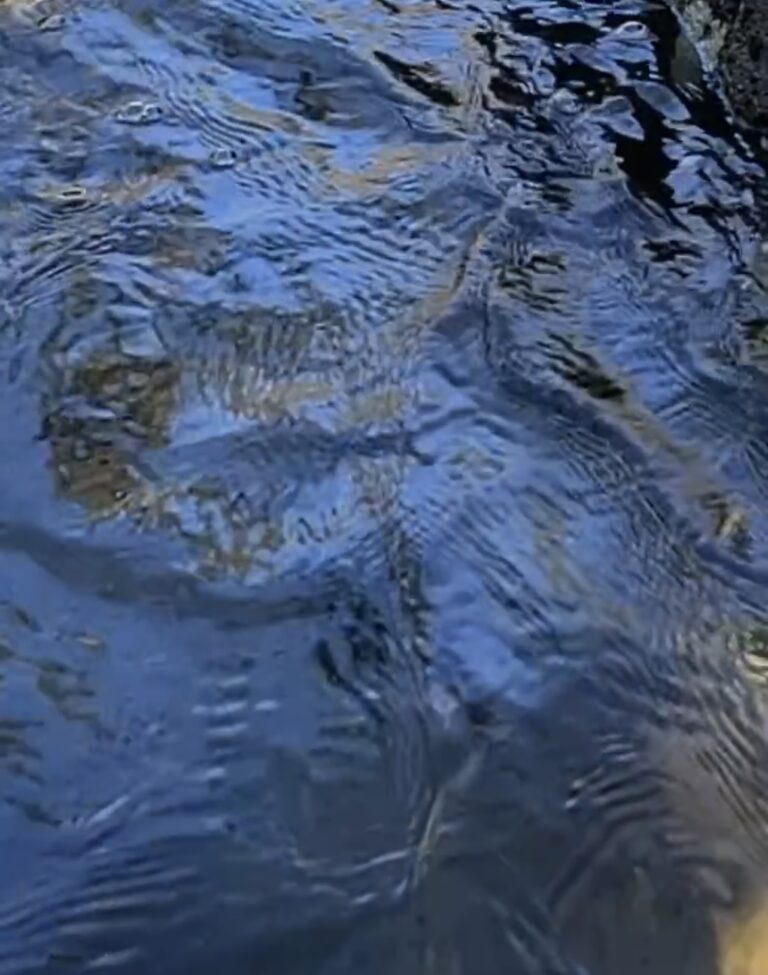
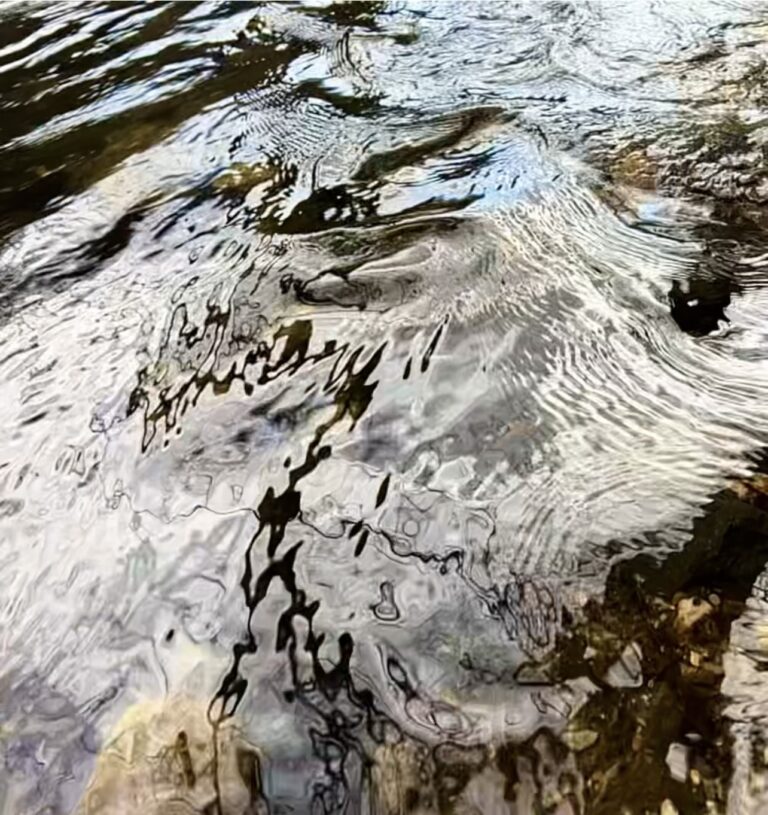
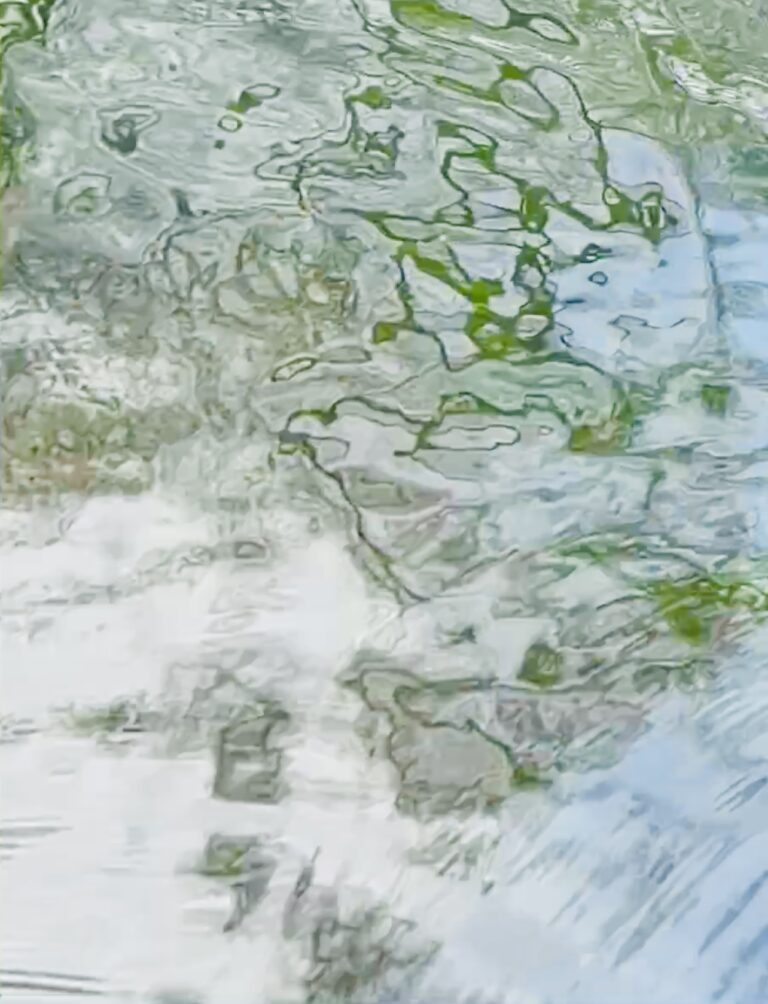
That day, I made a pact with myself to go back to the same place along the river every day, and sing the song. I began to notice that the water actually looked a bit different after I sang, so I started filming it on my.. I could see the forms in the water for the first time, really legibly, which was fantastic information for my paintings.
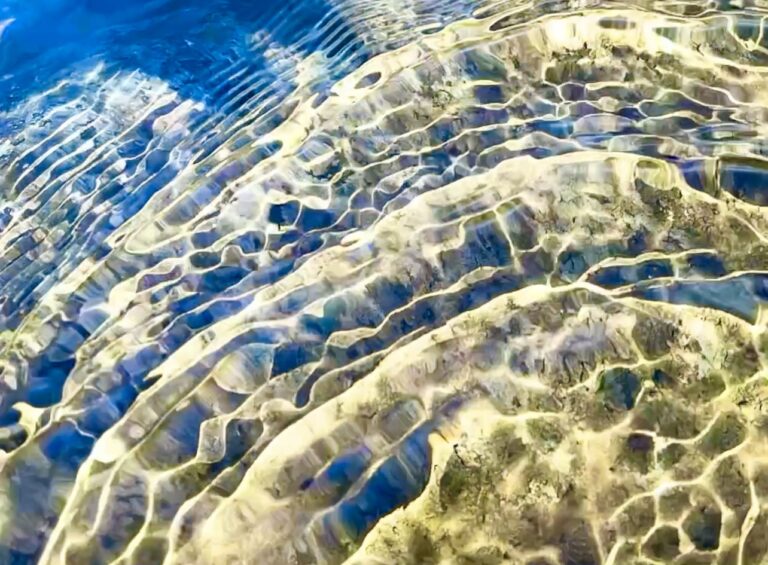
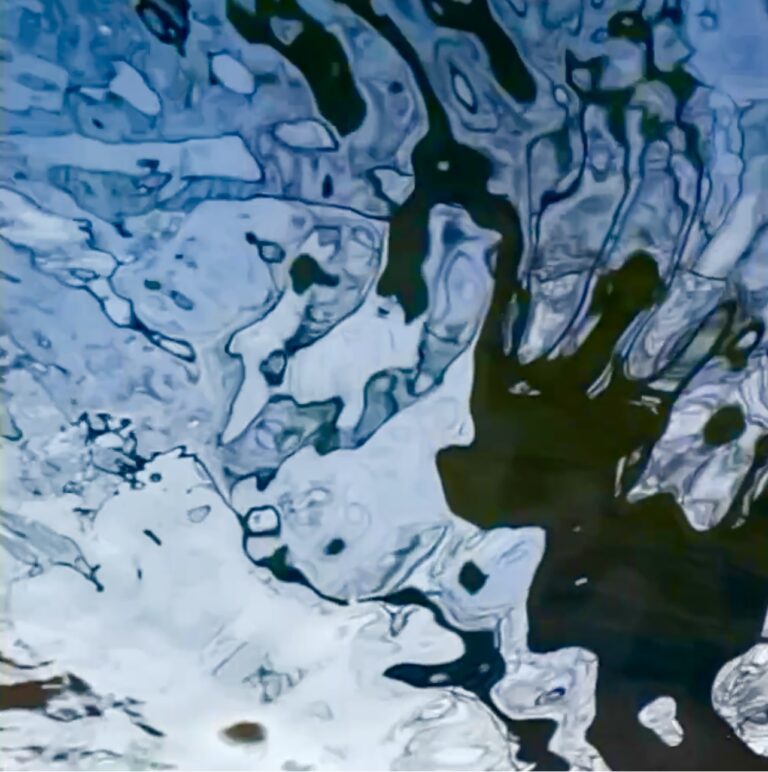
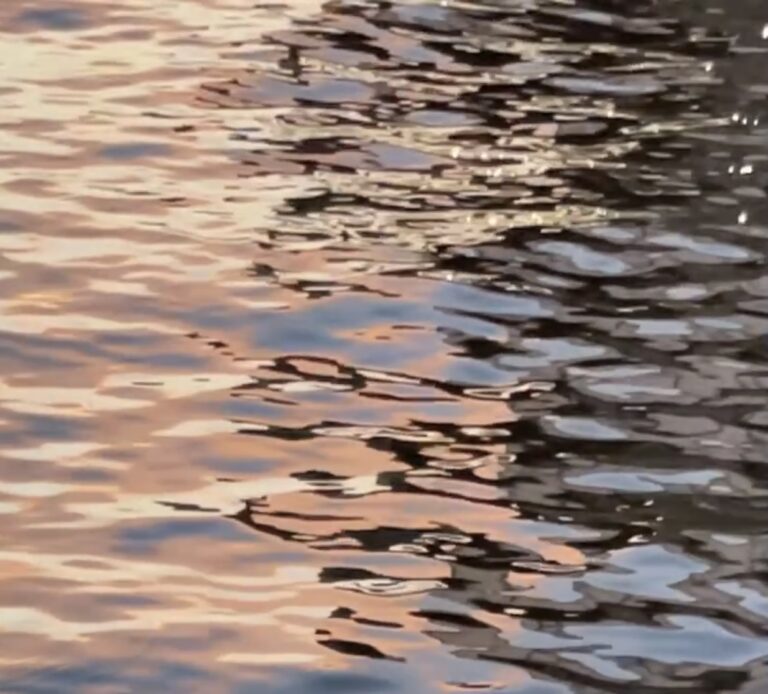
From these videos I could extract still images, which is what the viewer will see here.
Each picture is of very clean water. They reflect the vibrancy of the color in the sky and the sun. Every day that I can, I return to the river as part of my spiritual, artistic, and activist practice to document the beauty of clean water, and to fortify it with song as it goes out into the Hudson River.
These daily visits to the Croton River became an unexpected turning point in my studio practice. By slowing down the footage, I began to see recurring forms in the currents—shapes that were invisible to the naked eye but that revealed themselves through time and motion. These became what I call Water Archetypes, a visual vocabulary drawn directly from the behavior of living water. These archetypes eventually migrated into my paintings and began to function as a symbolic language. Through them, water became a framework for thinking about human identity, shared biology, and collective responsibility during the Anthropocene, the current geological age during which human activity has been the dominant influence on climate and the environment.
My art practice centers on the idea of “Portraiture” during the Anthropocene. It uses Platonic mimesis (i.e., the representation of nature, and in particular, human nature) as a point of departure to connect people to each other and the planet. My narrative system reflects John Cage’s idea that chance is the closest thing to nature. Since the vast majority (80 percent) of the human body is made up of water, it is also a natural platform for a nuanced discussion about neutrality and commonality among us humans,
Historically, portraits depict a person both by representational resemblance and using other descriptive tools and props. Clothing, posture, objects, or settings are often codes that directly or indirectly evoke class, power, profession, and personality.

In my portraits I seek to replace traditional codes with a completely new set that result from the combination of data and chance.
My invented system describes people without using their appearance. It serves to connect the subjects to one another and unite them in a common language. The only physical trait in the paintings is the height of the subject. This scales the portraits to the viewer’s perspective and makes the subject more relatable.
Most of the subjects are people I admire. I look for points of resistance and resilience to draw from in my own life as inspiration. How did they continually pick themselves up, over and over in order to accomplish that which they are known for? We all face similar challenges on our own journeys. And as da Vinci observed, “Water is the driving force of all nature.” And indeed, we are nature. We are water.
Note:
The images are from from the Nibi Water Song Videos.
Nibi means water in Anishinaabemowin, and the original Ojibwe/Chippewa Nibi song offers gratitude to the water. The videos are produced by filming the water after I sing the Nibi song.
Photography Summary
This is a three-part piece from an exhibition at Urban Glass, curated by Alpesh Kantilal Patel entitled Form and Formless: Constellations of Knowledge.

Megan Dyer
Artist / Musician / Climate Activist
Megan Dyer, a multifaceted artist, musician, climate activist and mother, has established a remarkable career marked by captivating solo shows, notable academic achievements, and insightful publications. Her artistic journey has been shaped by an exploration of the Anthropocene, using portraiture translated into neutral forms of nature like trees (time), water (the body) and sound (the spirit).
Her first solo show titled “Everything is Everything” in Brooklyn, NY, in 1997 set the stage for her future artistic endeavors. In 2000, at the Times Square Gallery solo show “Macro-Micro,” she captivated audiences with an exploration of microscopy and portraiture. Her solo exhibition “Transformator” at Gallery A Minor in Oslo, Norway in 2006, reflected her deep connection to nature. Notably, “Unframed First Look: A Salon for Painters” at Lehmann Maupin Gallery in New York, curated by Ross Bleckner, garnered attention and admiration from the art community. Most recently, she participated in two person show at Open for All in the West Village, NYTimes critic Seph Rodney curated her into a two women exhibition at Slag&Rx in Chelsea, and she launched her first Sonic Portrait of Sol LeWitt at Paula Cooper Gallery. Her solo exhibition in an endangered, sacred forest (the Buttonhook Forest, Chappaqua NY) was among her most joyful experiences.
Throughout her career, Megan Dyer’s artistic prowess and thought-provoking concepts have been featured in numerous publications such as “AM New York: the Villager,” which highlighted her scientific approach to portraiture. Additionally, publications like “Hyperallergic”, “Art News” and “New York Times” have delved into her process and the significance of her work.
Megan Dyer’s artistic journey has been marked by a relentless dedication to social and environmental activism as a lobbyist and organizer, and a drive to push the boundaries of her work. Dyer has carved out a distinctive place within the art world, making her a trailblazer in the intersection of art and artivism. More information about Megan is available at megandyer.com.
Water, Water Everywhere...
Leon Jackson Davenport
A Portrait of the Collective; As Water
Megan Dyer
Water-Related Art & Imagery
Suprina Troche and Susan Hillary Shapiro, Esq.


